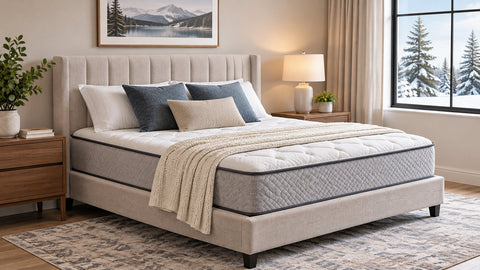

Finding the best mattress for back pain in Canada can feel overwhelming when almost every mattress manufacturer promises exceptional support, pressure relief, or improved spinal alignment. If you regularly wake up with a stiff lower back, experience discomfort around your hips, or struggle to find a comfortable sleeping position, your mattress may be one factor worth investigating. However, the best choice is not automatically the firmest or most expensive mattress. Your sleeping position, body weight, personal comfort preferences, and existing health concerns all influence which surface is most suitable.
This comprehensive 2026 buying guide explores what medical research says about mattress firmness, compares supportive mattress options from Sealy, TEMPUR-Pedic, and Polysleep, and explains how to evaluate memory foam, hybrid, and innerspring construction. We'll also examine mattress sizes, Canadian pricing considerations, warning signs of an unsupportive mattress, and practical shopping advice. Whether you're replacing an older bed or upgrading your entire sleep setup, explore mattresses available at Master Bedroom Stores while learning how to make a more informed decision.
Medical note: This guide provides general product information, not medical diagnosis or treatment advice. The mattresses discussed are retail options selected for their comfort and support features, not products clinically proven to treat back pain.
Best Mattresses for Back Pain in Canada 2026 Quick Comparison
A mattress that feels excellent to one person may feel uncomfortable to another. Rather than presenting an unverified medical ranking, this comparison highlights models with different firmness levels, materials, and support systems.
All six models below have product listings at Master Bedroom Stores. Their suitability is based on construction characteristics and intended comfort, not claims that they have been medically tested for back pain relief.
| Mattress Model | Construction | Comfort Feel | Best Starting Point For |
|---|---|---|---|
| Sealy Essentials Medium Tight Top | Pocket-coil innerspring | Medium | Balanced support shoppers |
| TEMPUR-ProAlign 2.0 Medium Hybrid | Foam and hybrid coils | Medium | Premium hybrid comfort |
| Polysleep 10" Firm/Semi-Firm | Multi-layer foam | Firm or Semi-Firm | Foam comfort and motion control |
| Sealy Posturepedic East-Haven Firm | Foam comfort and support system | Firm | Firmer-feel shoppers |
| TEMPUR-ProAlign 2.0 Medium Foam | Specialized memory foam | Medium | Contouring pressure relief |
| Sealy Essentials Firm Euro Top | Pocket-coil support | Firm | Traditional firmer comfort |
How We Selected These Mattresses
We reviewed construction specifications, firmness designations, cushioning materials, support systems, and practical ownership considerations.
Our selection considers:
-
Support: Whether the core is designed to distribute weight consistently.
-
Pressure relief: Materials intended to cushion shoulders, hips, and other contact areas.
-
Firmness: Availability of medium, semi-firm, or firm options.
-
Construction: Foam, individually wrapped coils, or hybrid combinations.
-
Ease of movement: How the mattress responds when changing positions.
-
Value: Whether the features suit different Canadian shopping budgets.
These recommendations are research-based comparisons, not results from personal mattress testing or clinician endorsements.
How Can a Mattress Affect Back Pain?
A mattress influences how the body is supported throughout the night. If the sleeping surface sags excessively or creates uncomfortable pressure, you may have difficulty finding a restful position.
However, back pain has many possible causes, including muscle strain, injury, nerve conditions, and other health concerns. Replacing a mattress may improve comfort when the existing surface is unsuitable, but it cannot diagnose or reliably correct an underlying medical problem.
Spinal Alignment and Sleeping Posture
Spinal alignment refers to the position of the spine while lying down. A comfortable sleeping surface should support the body without forcing it into an awkward posture.
For a side sleeper, this means allowing the shoulders and hips to settle comfortably while supporting the waist. Back sleepers may require more even support beneath the torso and pelvis.
Important considerations include:
-
Mattress firmness relative to body weight.
-
Support beneath the hips and lower back.
-
Shoulder and hip cushioning.
-
Sleeping position.
-
Pillow height.
-
Condition of the bed foundation.
Pressure Relief and Body Support
Pressure relief and support are not the same thing. Pressure relief describes how the surface cushions areas where body weight is concentrated, while support concerns how the mattress carries the body's overall weight.
Too little cushioning may create pressure discomfort. Excessive sinking may make a sleeping position feel unstable.
A suitable mattress should balance:
-
Comfortable cushioning.
-
Consistent underlying support.
-
Controlled sinking.
-
Ease of changing positions.
-
Appropriate firmness for the sleeper.
Why an Extremely Firm Mattress Is Not Always Better
Many shoppers believe that anyone experiencing back pain should sleep on the hardest mattress available.
That assumption is not consistently supported by clinical research. A very firm surface may create uncomfortable pressure for certain people, particularly around the shoulders and hips.
Medium-firm mattresses can provide a useful starting point, but their suitability still depends on individual needs.
What Mattress Firmness Is Best for Back Pain?

Mattress firmness describes how soft or resistant the sleeping surface feels under body weight. Unfortunately, manufacturers do not all use an identical firmness scale.
A mattress described as medium-firm by one company may feel noticeably different from another mattress carrying the same designation.
Medium-Firm Mattresses
Medium-firm mattresses are frequently discussed in research on sleep comfort and nonspecific lower back pain.
A randomized controlled trial involving 313 adults with chronic nonspecific low-back pain found that participants assigned medium-firm mattresses experienced better outcomes on several measures than those assigned firm mattresses over 90 days.
This finding supports considering medium-firm surfaces, but it does not establish a universal prescription or prove that a particular retail model treats back pain.
Potential advantages:
-
Balance of cushioning and resistance.
-
Comfortable starting point for many back sleepers.
-
Support without an excessively hard surface.
-
Availability in foam and spring designs.
Firm Mattresses
Firm mattresses provide greater resistance to sinking and may appeal to people who prefer a more stable surface.
They are worth comparing when your current mattress allows your hips or abdomen to sink uncomfortably.
Potential advantages:
-
Less perceived sinking.
-
Responsive support in some constructions.
-
Suitable for certain stomach and back sleepers.
-
A distinct alternative to plush mattresses.
Potential disadvantages: Some side sleepers may experience uncomfortable shoulder or hip pressure on a very firm surface.
Soft and Plush Mattresses
Soft mattresses generally provide more cushioning near the upper surface.
That can be appealing to certain side sleepers, especially when their shoulders and hips require additional pressure relief. However, the underlying support still needs to be appropriate.
Mattress Firmness Comparison
| Comfort Level | General Feel | Common Shopping Consideration |
|---|---|---|
| Soft | Deep cushioning | Pressure relief for some side sleepers |
| Medium | Balanced cushioning | Side and combination sleeper comfort |
| Medium-Firm | More support resistance | Common starting point for back support |
| Firm | Limited sinking | Firmer-feel back and stomach sleepers |
| Extra Firm | Very resistant surface | Specific preferences rather than default back-pain advice |
Buying tip: Compare mattresses using your normal sleeping position rather than selecting solely from a firmness number.
Best Mattresses for Back Pain in Canada Detailed Picks
The following mattress options illustrate different approaches to cushioning and support. Their inclusion does not mean that any model has been clinically proven to reduce back pain.
1. Sealy Essentials Medium Tight Top Best Balanced Support Option
The Sealy Essentials Medium Tight Top Mattress is a practical starting point for shoppers interested in moderate cushioning combined with traditional pocket-coil construction.
Its product listing describes an approximately 11-inch profile, PostureTouch pocket-coil support, and comfort materials intended to create a medium feel.
Key features:
-
Medium comfort designation.
-
Individually wrapped pocket-coil system.
-
High-density comfort foam.
-
Edge support construction.
-
Tight-top mattress design.
-
Multiple standard size options.
Why consider it?
A medium-feel mattress can be a reasonable comparison point for shoppers who find very soft or very firm beds uncomfortable.
The pocket-coil system may provide a responsive feel while the comfort layers cushion the body.
Potential limitation: Some sleepers may require more contouring or firmer support than this model provides.
Best suited for: Shoppers exploring balanced cushioning and conventional mattress support.
2. TEMPUR-ProAlign 2.0 Medium Hybrid Best Premium Hybrid Option
The TEMPUR-ProAlign 2.0 Medium Hybrid Mattress combines TEMPUR comfort materials with a hybrid support system.
Hybrid construction is worth considering when you want both contouring cushioning and some of the responsiveness associated with springs.
Key features:
-
Medium comfort designation.
-
Hybrid foam-and-coil construction.
-
Pressure-adapting TEMPUR material.
-
Premium mattress construction.
-
Approximately 12-inch profile.
Why consider it?
The combination of foam and coils provides an alternative to traditional innerspring designs and all-foam mattresses.
It is especially relevant for shoppers comparing pressure-relieving cushioning against responsiveness and ease of movement.
Potential limitation: Its premium price may not be justified for every buyer. Personal comfort testing remains important.
Best suited for: Customers exploring premium hybrid construction and medium-feel support.
3. Polysleep 10" Mattress Best Firm or Semi-Firm Foam Option
The Polysleep 10" Firm or Semi-Firm Mattress offers a foam-based sleeping surface with different comfort choices.
Its listed construction includes layered foam, open-cell comfort materials, and reinforced edge support.
Key features:
-
Approximately 10-inch profile.
-
Firm or Semi-Firm options.
-
Multiple foam layers.
-
Open-cell comfort foam.
-
Reinforced perimeter.
-
Canadian manufacturing listed.
Why consider it?
Foam mattresses can provide a more contouring sensation than conventional interconnected-coil designs.
A semi-firm option may be worth exploring if you want cushioning without the deep sinking associated with some plush mattresses.
Potential limitation: All-foam construction may feel less responsive than a traditional spring mattress.
Best suited for: Foam mattress shoppers, motion-sensitive couples, and people comparing different levels of support.
Browse other options through the mattress-in-a-box collection.
4. Sealy Posturepedic East-Haven Firm Best Firmer-Feel Alternative
The Sealy Posturepedic East-Haven Firm Mattress is worth comparing if you prefer a firmer surface.
The model's listing describes a tight-top configuration with Bio-Gel and latex-related comfort materials, combined with support-focused construction.
Key features:
-
Firm comfort designation.
-
Tight-top design.
-
Comfort materials incorporating gel and latex-related technologies.
-
Support-focused mattress construction.
-
Multiple size configurations.
Why consider it?
Some shoppers who dislike excessive sinking may prefer a firmer surface.
This model provides a distinct alternative to medium-feel and plush mattresses.
Potential limitation: A firm mattress may create pressure discomfort for some side sleepers.
Best suited for: Customers who want to compare firmer support without assuming that maximum firmness is medically necessary.
5. TEMPUR-ProAlign 2.0 Medium Memory Foam Best Contouring Foam Option
The TEMPUR-ProAlign 2.0 Medium Memory Foam Mattress is designed around TEMPUR's distinctive pressure-responsive foam feel.
Unlike spring-supported mattresses, all-foam designs may provide a slower and more closely contouring sensation.
Key features:
-
Medium comfort option.
-
TEMPUR pressure-adapting material.
-
Approximately 12-inch profile.
-
All-foam construction.
-
Premium comfort positioning.
Why consider it?
Some shoppers value a surface that conforms around their shoulders, hips, and torso.
Foam construction can also be relevant when minimizing partner movement disturbance is important.
Potential limitation: People who prefer immediate spring responsiveness may find the material's slower feel less appealing.
Best suited for: Customers seeking contouring cushioning and a premium foam mattress experience.
6. Sealy Essentials Firm Euro Top Best Traditional Firm Option
The Sealy Essentials Firm Euro Top Mattress combines a firmer comfort designation with Euro-top cushioning.
Its listing describes a pocket-coil support system and reinforced edge construction.
Key features:
-
Firm comfort designation.
-
Euro-top surface.
-
Pocket-coil construction.
-
Edge support components.
-
Traditional mattress feel.
Why consider it?
This mattress is worth testing if you prefer a firmer support sensation while still wanting upper-surface cushioning.
It also provides an accessible comparison against more expensive models.
Potential limitation: Firm Euro-top construction may still feel too resistant for some sleepers.
Best suited for: Buyers seeking traditional firmer support and straightforward mattress construction.
Memory Foam vs. Hybrid vs. Innerspring for Back Support
Mattress construction influences how weight is distributed, how the surface responds, and how easily the sleeper moves.
No material is automatically superior for every person with back discomfort. Comparing constructions helps identify the specific characteristics you prefer.
Memory Foam Mattresses
Memory foam adapts to pressure and can create a close-fitting sensation.
Potential advantages:
-
Contouring cushioning.
-
Reduced movement transfer in many designs.
-
Multiple firmness choices.
-
Pressure distribution across body contact areas.
Potential drawbacks:
-
Deep sinking in some models.
-
Less immediate responsiveness.
-
Variable temperature comfort.
Hybrid Mattresses
Hybrid mattresses combine foam cushioning with an underlying coil support system.
Potential advantages:
-
Combination of contouring and spring responsiveness.
-
Several firmness configurations.
-
Different edge reinforcement options.
-
Potential airflow through coil systems.
Potential drawbacks:
-
Generally more complex construction.
-
Potentially higher prices.
-
Considerable variation between brands.
Innerspring Mattresses
Innerspring mattresses use coils as their principal support structure.
Potential advantages:
-
Traditional mattress responsiveness.
-
Wide availability.
-
Multiple price categories.
-
Different surface cushioning designs.
Potential drawbacks:
-
Motion transfer varies by coil type.
-
Simpler models may have fewer comfort layers.
-
Construction quality differs considerably.
Mattress Construction Comparison
| Mattress Type | Feel | Key Buying Priority |
|---|---|---|
| Memory Foam | Contouring | Pressure relief and motion control |
| Hybrid | Balanced and responsive | Foam comfort plus coil support |
| Pocket-Coil Innerspring | Responsive | Independent coil response |
| Traditional Innerspring | Spring-based | Familiar comfort and value |
| Latex Foam | Responsive cushioning | Material feel and construction |
Explore additional options in the Master Bedroom mattress collection.
Choosing a Mattress for Your Sleeping Position

Your usual sleeping position influences which parts of the body contact the mattress most strongly.
A well-matched mattress should feel comfortable without causing excessive sinking or unwanted pressure.
Best Mattress for Back Sleepers
Back sleepers generally need consistent support beneath the torso and pelvis.
A medium or medium-firm mattress is often a reasonable starting point, although some individuals prefer firmer support.
Look for:
-
Even cushioning.
-
Stable pelvic support.
-
Comfortable lower-back positioning.
-
Limited excessive sinking.
Compare medium-feel pocket-coil and hybrid mattresses before deciding.
Best Mattress for Side Sleepers
Side sleepers place considerable pressure on their shoulders and hips.
A very firm mattress may create discomfort at these contact points, while an overly soft design may allow excessive hip sinking.
Look for:
-
Shoulder cushioning.
-
Hip pressure relief.
-
Support beneath the waist.
-
Comfortable side-to-side movement.
A medium-feel foam or hybrid mattress may be a useful comparison point.
Best Mattress for Stomach Sleepers
Stomach sleepers often prefer firmer surfaces because significant sinking beneath the abdomen may feel uncomfortable.
However, firmness should not be selected without considering body weight and individual preferences.
Look for:
-
Controlled midsection sinking.
-
Stable support.
-
Comfortable shoulder positioning.
-
Appropriate pillow height.
Best Mattress for Combination Sleepers
Combination sleepers move between several positions throughout the night.
A mattress should provide cushioning while allowing relatively easy movement.
Look for:
-
Medium or medium-firm comfort.
-
Responsive materials.
-
Suitable pressure relief.
-
Stable edges.
For additional guidance, read the Master Bedroom article on mattresses for side and stomach sleepers with back pain.
What to Look for in a Mattress When You Have Back Pain
Choosing a mattress involves more than deciding between soft and firm.
The overall support system, sleeping surface, foundation, and practical ownership features all affect everyday comfort.
1. Appropriate Support
The mattress should accommodate your body without creating excessive sagging.
Check how the surface feels beneath the pelvis, waist, shoulders, and hips.
2. Comfortable Pressure Relief
Cushioning should reduce uncomfortable contact pressure without allowing uncontrolled sinking.
Side sleepers may prioritize this feature more strongly than some stomach sleepers.
3. Suitable Mattress Height
Mattress thickness influences total bed height and ease of getting in and out of bed.
A very thick mattress may require an appropriately sized fitted sheet and a suitable foundation.
4. Edge Stability
Edge support matters when sitting on the bed or moving from lying down to standing.
A stable perimeter may be particularly valuable for people who find getting out of bed uncomfortable.
5. Motion Isolation
When sharing a mattress, partner movement can interrupt sleep.
Foam and pocket-coil constructions are worth comparing if movement disturbance is a concern.
6. Compatible Foundation
A mattress needs appropriate support beneath it.
An unsuitable bed frame, damaged foundation, or widely spaced slats may affect comfort and potentially conflict with manufacturer requirements.
7. Warranty and Exchange Terms
Review the actual warranty and comfort exchange conditions before purchasing.
A warranty addresses specified product defects and does not guarantee relief from back pain.
When Should You Replace an Unsupportive Mattress?
An aging mattress may lose support or develop uneven sleeping areas over time.
However, mattress age alone is not enough to determine whether replacement is necessary.
Signs Your Mattress May Need Replacing
-
Visible sagging or deep permanent impressions.
-
Uneven support across the surface.
-
Damaged springs or weakened foam.
-
Significant edge deterioration.
-
Persistent discomfort associated with the sleeping surface.
-
Difficulty finding a comfortable sleeping position.
-
An unsupportive or damaged foundation.
Can a Mattress Topper Help?
A topper can change the surface feel of a structurally sound mattress.
For example, a topper may add cushioning to a mattress that feels too firm.
However, it cannot reliably correct damaged springs, major sagging, or a collapsed support system.
Browse mattress toppers at Master Bedroom Stores if your mattress remains supportive but needs a different surface feel.
What Does Medical Research Say About Mattresses and Back Pain?
Research suggests that mattress characteristics can influence sleep comfort and some back-pain outcomes.
However, findings are not strong enough to establish one ideal commercial mattress for every person or medical condition.
Evidence Supporting Medium-Firm Mattresses
A frequently cited randomized study published in The Lancet in 2003 compared firm and medium-firm mattresses in 313 adults with chronic nonspecific low-back pain.
Participants using medium-firm mattresses had better results on several pain and disability measures over the study period.
This supports considering medium-firm mattresses rather than automatically choosing the firmest available surface.
What Systematic Reviews Suggest
A 2018 systematic review of controlled mattress studies found evidence favouring certain medium-firm and individually adapted mattress characteristics for sleep comfort and spinal positioning.
More recent reviews have also emphasized the interaction between mattress materials, body weight, sleeping posture, and individual preferences.
Important limitations include:
-
Studies involve different mattress types.
-
Firmness definitions vary.
-
Participant characteristics differ.
-
Some studies are relatively small.
-
Results do not prove that a particular retail model treats back pain.
Why No Mattress Can Guarantee Relief
Back pain may involve multiple contributing factors beyond the sleeping surface.
A mattress can influence comfort during sleep, but it cannot replace medical assessment, physical rehabilitation, or other appropriate treatment.
When to seek medical help: Consult a qualified healthcare professional if pain persists, worsens, follows an injury, or is accompanied by concerning symptoms. New loss of bladder or bowel control, numbness around the groin or saddle area, or severe progressive leg weakness requires urgent medical assessment.
Mattress Prices in Canada — What Should You Expect?
The cost of a supportive mattress varies by size, construction, material quality, and manufacturer.
A higher price does not necessarily mean a better choice for back comfort.
| Approximate Budget (CAD) | Typical Shopping Category |
|---|---|
| Under $500 | Entry-level mattress |
| $500–$1,000 | Affordable to mid-range |
| $1,000–$1,800 | Mid-range and selected premium models |
| $1,800–$3,000 | Premium mattresses |
| Over $3,000 | Luxury and specialized comfort models |
These are approximate shopping categories, not guaranteed current prices for individual mattresses.
Is an Expensive Mattress Better for Back Support?
Not necessarily. A well-matched lower-priced mattress may feel more comfortable than a premium model with unsuitable firmness.
Compare:
-
Support construction.
-
Comfort materials.
-
Firmness designation.
-
Mattress size.
-
Warranty coverage.
-
Foundation requirements.
-
Delivery charges.
-
Exchange conditions.
How to Shop for Better Value
Start with your preferred firmness and construction type.
Then compare models within your budget rather than selecting the most expensive mattress first.
Review current offers through the Master Bedroom mattress collection.
Practical Tips for a More Comfortable Sleep Setup
A mattress is only one part of your overall sleeping environment.
Pillows, bed foundations, room conditions, and sleeping habits also influence comfort.
Choose a Suitable Pillow
Your pillow should support your head and neck comfortably.
Side sleepers may prefer sufficient pillow height to fill the gap between the shoulder and head, while back sleepers often benefit from a different profile.
Check Your Bed Foundation
Verify that the frame and foundation are compatible with your mattress.
A sagging foundation can affect the support provided by an otherwise suitable mattress.
Consider Your Sleeping Position
Some people find that placing a pillow between the knees while side sleeping, or beneath the knees while lying on the back, makes their position more comfortable.
These adjustments are personal comfort measures rather than treatments for underlying spinal conditions.
Review Your Bedroom Environment
Temperature, noise, lighting, and bedding can affect sleep quality.
A comfortable environment may help reduce nighttime disturbances even when the mattress itself is suitable.
Avoid Choosing by Marketing Claims Alone
Terms such as orthopedic, therapeutic, or doctor-recommended are not substitutes for verified medical evidence.
Focus on construction, individual comfort, and credible product information.
How to Choose the Best Mattress for Back Pain in Canada
A structured shopping process can help you compare available options without becoming overwhelmed by product terminology.
Use the following checklist before purchasing.
Step 1: Identify Your Comfort Priorities
Think about what feels uncomfortable on your current mattress.
Is it too soft, too firm, uneven, or difficult to move on?
Step 2: Consider Your Sleeping Position
Determine whether you primarily sleep on your side, back, stomach, or a combination.
Use that information to narrow your initial firmness choices.
Step 3: Compare Mattress Construction
Explore memory foam, hybrid, and pocket-coil mattresses.
Consider how each type feels rather than assuming one construction is medically superior.
Step 4: Check Size and Fit
Confirm mattress dimensions, available bedroom space, and foundation compatibility.
Queen and king mattresses may suit couples differently depending on room size and preferred personal space.
Step 5: Test the Mattress Where Possible
Lie in your usual sleeping position and pay attention to the comfort of your shoulders, waist, hips, and lower back.
Avoid choosing based only on briefly sitting at the edge.
Step 6: Review the Purchase Terms
Confirm:
-
Current price in CAD.
-
Selected mattress size.
-
Delivery availability.
-
Foundation requirements.
-
Warranty limitations.
-
Exchange conditions.
-
Applicable fees.
-
Product availability.
Where to Shop for Supportive Mattresses in Canada
Canadian customers can compare different mattress types through specialist retailers, furniture stores, and manufacturer websites.
Shopping online helps with specification comparisons, while visiting a showroom allows you to experience different comfort levels.
Explore Master Bedroom Stores
Master Bedroom Stores offers several mattress categories, including Sealy, TEMPUR-Pedic, Polysleep, and other brands.
Useful shopping resources include:
-
All Mattresses — Compare different comfort systems.
-
Sealy Mattresses — Explore medium and firm options.
-
TEMPUR-Pedic Mattresses — Review contouring foam and hybrid designs.
-
Mattress in a Box — Compare packaged mattress choices.
-
Adjustable Beds — Explore compatible adjustable foundations.
Shopping in Whitby and Durham Region
Customers in Whitby and surrounding Ontario communities can review mattress listings online and verify store availability before visiting.
For additional local advice, explore the Master Bedroom mattress shopping guide for Whitby.
Understand the Sleep Trial
Master Bedroom Stores publishes a 90-night mattress trial policy for qualifying purchases.
The policy describes eligibility, an adjustment period, and exchange conditions. Fees and other restrictions may apply, so confirm the current terms before checkout.
Final Verdict Finding the Best Mattress for Back Pain in Canada
The best mattress for back pain in Canada is not necessarily the firmest, softest, or most expensive model. A comfortable mattress should balance suitable support with appropriate cushioning, taking your body weight, sleeping position, and preferences into account. Research suggests medium-firm surfaces are worth considering for some people with nonspecific lower back pain, but evidence does not establish a universally effective mattress or prove that any particular retail model provides medical treatment.
For a balanced starting point, compare the Sealy Essentials Medium Tight Top. Shoppers interested in premium hybrid construction can explore the TEMPUR-ProAlign Medium Hybrid, while the Polysleep 10-inch mattress offers firm and semi-firm foam alternatives. Customers preferring firmer traditional comfort can investigate Sealy's East-Haven Firm or Essentials Firm Euro Top. Ready to compare supportive mattress options? Browse mattresses at Master Bedroom Stores, review verified specifications, and choose a model that suits your comfort needs and Canadian-dollar budget.
Frequently Asked Questions About Mattresses for Back Pain
1. What is the best mattress for back pain in Canada in 2026?
The best mattress for back pain in Canada depends on individual sleeping preferences, body weight, comfort requirements, and the cause of discomfort. A medium or medium-firm mattress may be a useful starting point because some research suggests these surfaces can offer a favourable balance of cushioning and support. However, no particular brand or retail mattress has been established as universally effective for treating back pain. Compare different constructions and consult a healthcare professional for persistent symptoms.
2. Is a firm mattress better for lower back pain?
A firm mattress is not automatically better for lower back pain. Research comparing firm and medium-firm mattresses has found better outcomes with medium-firm surfaces among some adults with chronic nonspecific lower back pain. However, individuals vary considerably in body weight, sleeping position, and comfort needs. Some people prefer firmer support, while others need more cushioning. The ideal mattress should feel supportive without creating excessive pressure or uncomfortable sinking.
3. Can a mattress make back pain worse?
An unsuitable mattress may contribute to uncomfortable sleeping positions, excessive pressure, or disrupted sleep, which can worsen perceived discomfort for some people. However, back pain has many possible causes, and a mattress should not automatically be blamed for persistent symptoms. If your mattress has significant sagging, damaged support, or an uncomfortable firmness level, replacement may be worth considering. Continuing or worsening back pain should be assessed by a qualified healthcare professional.
4. Is memory foam good for back pain?
Memory foam can provide contouring comfort and pressure distribution, which some sleepers find beneficial. However, the suitability of memory foam depends on its firmness, density, construction, and the sleeper's individual preferences. A very soft foam mattress may allow excessive sinking, while a firmer foam design may feel more supportive. Memory foam is not a medical treatment for back pain. Compare it with hybrid and innerspring mattresses to determine which construction feels most comfortable.
5. What mattress firmness is best for spinal alignment?
There is no single firmness level that ensures ideal spinal alignment for every person. The most suitable surface should support the torso and pelvis while providing comfortable cushioning around pressure points. Medium or medium-firm mattresses are common starting points, but body weight and sleeping position can change the result. Side sleepers may require additional shoulder and hip cushioning, while some stomach sleepers prefer firmer support. Personal comfort testing is important.
6. Should I buy an orthopedic mattress for back pain?
An orthopedic label does not automatically mean a mattress has been medically tested or proven to relieve back pain. Different manufacturers use this terminology for a range of support-focused products. Before buying, examine the actual construction, firmness, cushioning materials, warranty, and comfort features rather than relying on the label alone. A mattress that feels suitably supportive may be more practical than one promoted with unverified therapeutic claims.
7. Can a new mattress cure chronic back pain?
No mattress can be relied upon to cure chronic back pain. A new mattress may improve comfort if an existing sleeping surface is damaged or unsuitable, but chronic pain can involve musculoskeletal, neurological, and other medical factors. Appropriate treatment may require assessment by a physician or another qualified healthcare professional. Seek urgent medical attention for new bladder or bowel control problems, saddle-area numbness, or severe progressive leg weakness.
8. Where can I buy a supportive mattress in Canada?
Canadians can compare supportive mattresses through specialist retailers, furniture stores, and manufacturer websites. Master Bedroom Stores offers several mattress brands and constructions, including Sealy, TEMPUR-Pedic, and Polysleep. Customers can explore the mattress collection, compare comfort levels and product specifications, and review current delivery and warranty information. For shoppers experiencing back discomfort, prioritizing appropriate support and personal comfort is more useful than relying solely on marketing claims.